Reviewed · TICKETS
Beijing: Confucius Temple and the Impercial College E-ticket
Beijing’s Confucius Temple and Imperial College give you two historic sites in one quiet complex. The highlight is not a grand view, but the 51,624 names carved on stone tablets, a remarkable record of the people who passed China’s imperial examinations. The buildings date mainly from the Yuan Dynasty, when Beijing was taking shape as a major capital.
I like the easy QR-code entry and the chance to see Yuan Dynasty architecture without paying much. I also like the way the temple and college explain two sides of Confucian society: honoring the teacher and training the officials who ran the state. The main drawback is that this is an e-ticket, not a guided tour, so you may want the audio guide available at the entrance if you want more explanation.
In This Review
- Key points at a glance
- Why the imperial examination tablets matter
- Entering Beijing’s Confucius Temple
- Following the Imperial College axis
- What you will see in the exhibitions
- A $7 ticket and what you actually get
- QR entry, passport rules, and practical details
- How much time should you allow?
- Who will enjoy this visit most?
- What the rating tells you
- Should you book the Confucius Temple and Imperial College ticket?
- FAQ
- How much does the Confucius Temple and Imperial College ticket cost?
- How long is the ticket valid?
- What does the ticket include?
- Do I need to bring my passport?
- Can I enter with a QR code?
- Can I skip the ticket line?
- Is the attraction wheelchair accessible?
- Can I cancel the booking?
- Is a guide included?
Key points at a glance
- 51,624 examination names: Stone tablets record the names, birthplaces, and ranks of successful jinshi candidates.
- Two connected institutions: The Confucius Temple honored Confucius, while the Imperial College trained and administered education for the state.
- Yuan Dynasty foundations: The temple dates to 1306, and the Imperial College was built in 1308.
- Three courtyards each: Both compounds follow a formal central axis with gates, halls, and side pavilions.
- Simple admission: Bring your original passport and use the electronic ticket QR code at the attraction.
- Low-cost cultural stop: At about $7 per person, this is a useful choice for a self-guided half-day visit within a one-day ticket validity period.
Why the imperial examination tablets matter
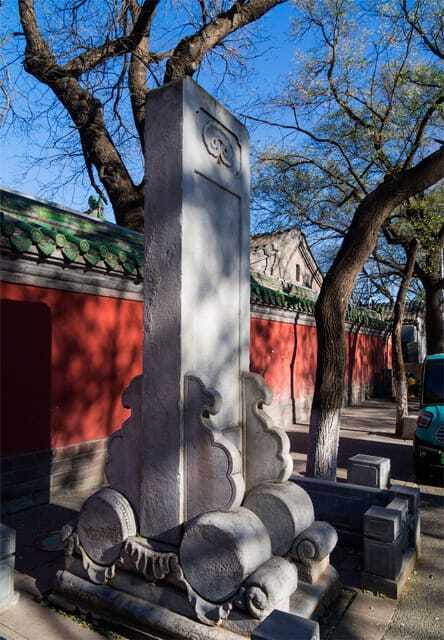
The stone tablets are the strongest reason to visit. Across 198 tablets, the complex records 51,624 successful jinshi candidates, along with their birthplaces and official ranks. These were not casual school certificates. The jinshi degree belonged to the highest level of China’s civil service examination system.
That system shaped Chinese government for centuries. A candidate’s education, writing ability, and command of Confucian classics could open the way to public office. The tablets turn that huge historical system into something you can see in physical form, name by name.
I would not rush past them. Even if you cannot read the classical Chinese inscriptions, the scale is clear. Rows of carved stone show how organized and competitive official education had become. The site also gives you a useful reminder that success in imperial China depended heavily on study, family support, and the ability to pass several levels of examination.
The drawback is that the tablets are primarily visual evidence. Without a guide or audio explanation, their importance may not be obvious at first. The audio guide sold at the temple entrance can help, according to the available visitor information, though it is not included in the ticket price.
A few more Beijing options to compare side by side
- Beijing: Forbidden City Tour(Group/Private)-Tickets Included
★ 4.8 · 7,974 reviews - Beijing: Mutianyu Great Wall Daily Tour with Ticket & Lunch
★ 5.0 · 3,056 reviews - 4-Hour Small Group Tour to Forbidden City with Entry Tickets
★ 5.0 · 1,863 reviews
Entering Beijing’s Confucius Temple
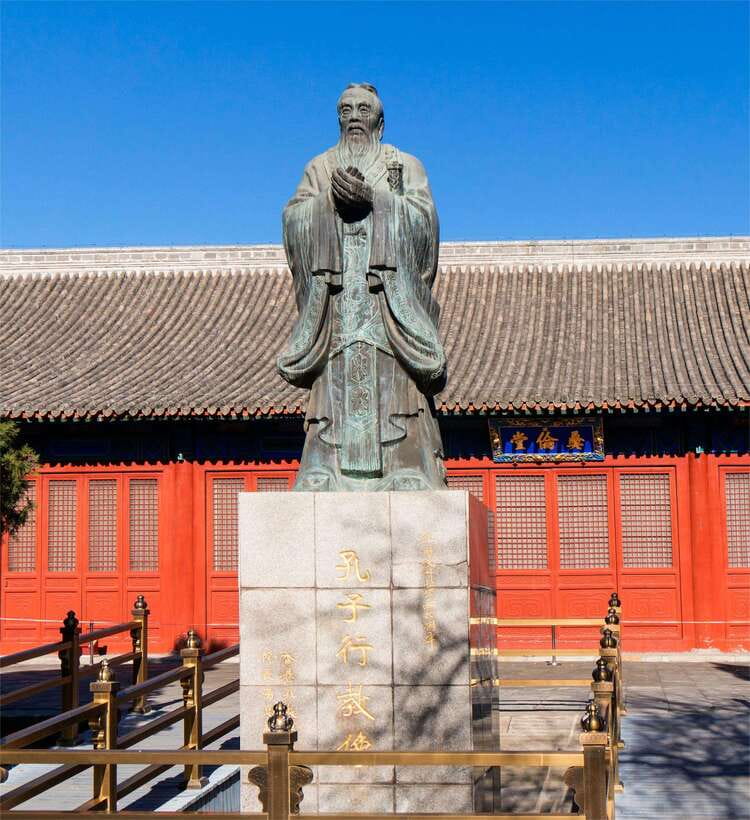
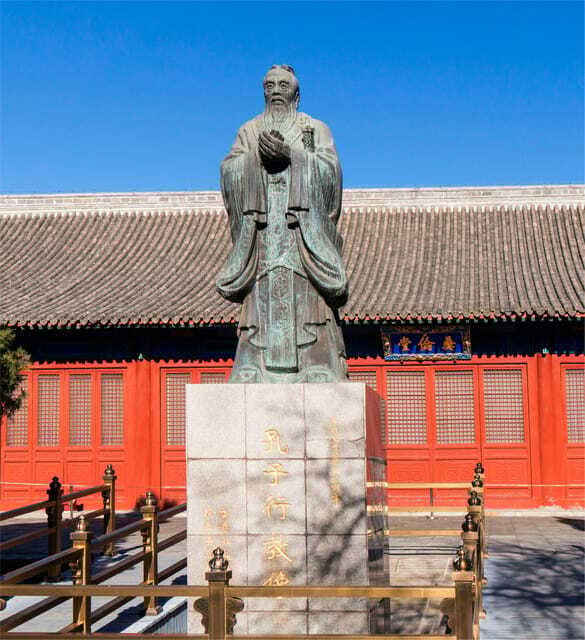
The Confucius Temple was built in 1306, during the Yuan Dynasty. It served as the place for memorial ceremonies honoring Confucius during the Yuan, Ming, and Qing periods.
The temple covers more than 22,000 square meters, with about 7,400 square meters of building area. Its layout follows a central south-to-north axis, so you move through a clear sequence of spaces rather than wandering through a loose collection of buildings.
The main route runs through:
- Teacher Gate
- Dacheng Gate
- Dacheng Hall
- Chong Sheng Temple
This arrangement reflects the formal nature of Confucian ritual. Each gate marks a change in status and atmosphere, while the halls at the center and rear give the complex its ceremonial focus.
The Dacheng Hall is especially important. It was the central hall for ceremonies connected with Confucius, and one of the current displays presents a restored version of the hall. You can also find exhibitions on Confucius and the history of the Beijing Confucius Temple.
The site is not presented as a modern attraction with constant entertainment. That is part of its appeal. You move through courtyards, examine carved stone, and think about the role of education and government in Chinese history. For some people, the quiet formality will be the point. Others may find it less immediately dramatic than Beijing’s imperial palaces.
Following the Imperial College axis
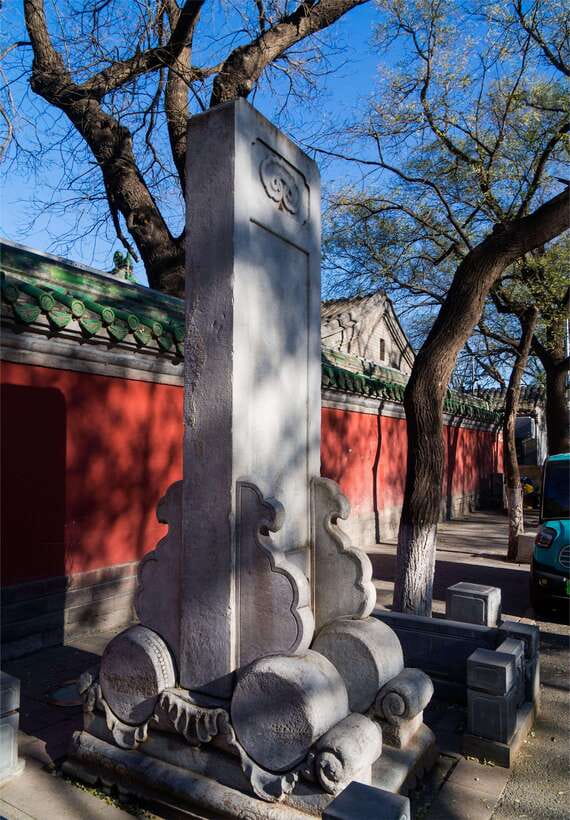
The Imperial College sits beside the temple in the traditional arrangement known as temple on the left and college on the right. Together, the two institutions explain the ideals behind the examination system.
The college was built in 1308, during the Yuan Dynasty. It was the highest educational institution and state education administration body during the Yuan, Ming, and Qing dynasties. In simple terms, this was where the official educational system was managed and where elite students pursued the learning needed for public service.
The route follows another central axis:
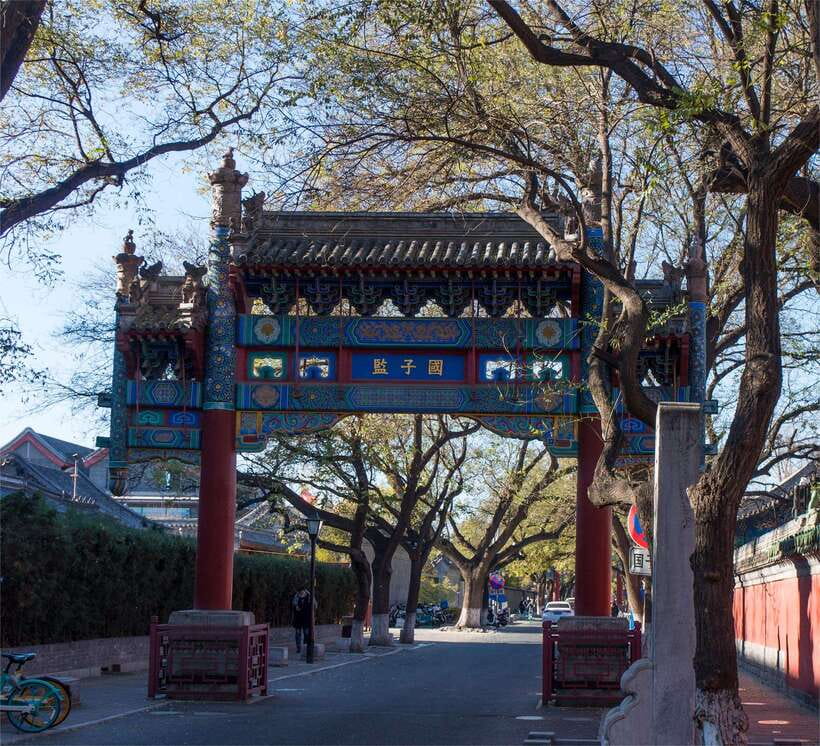
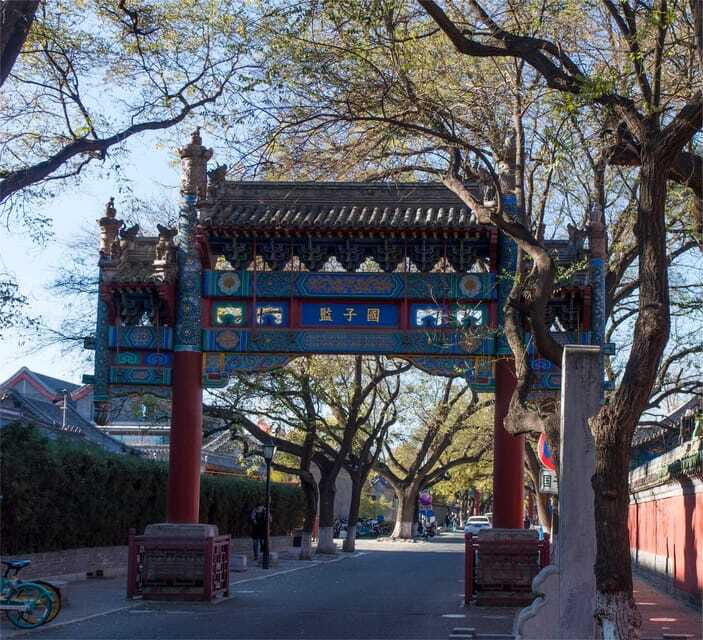
- Jixian Gate
- Taixue Gate
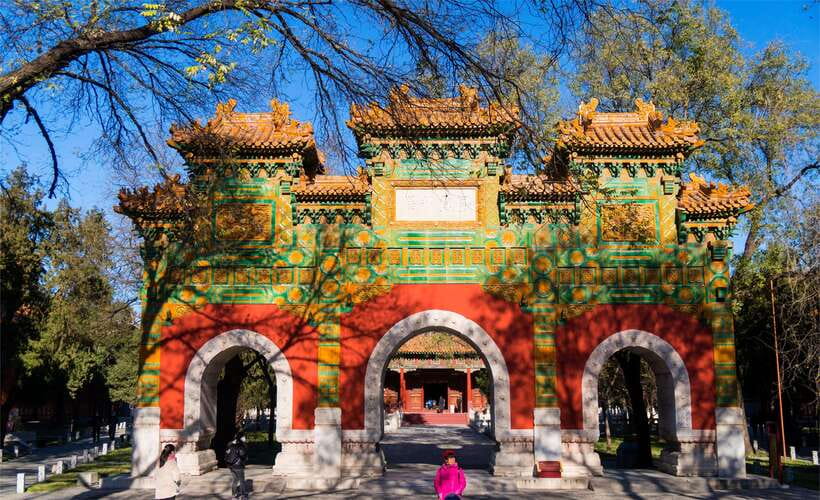
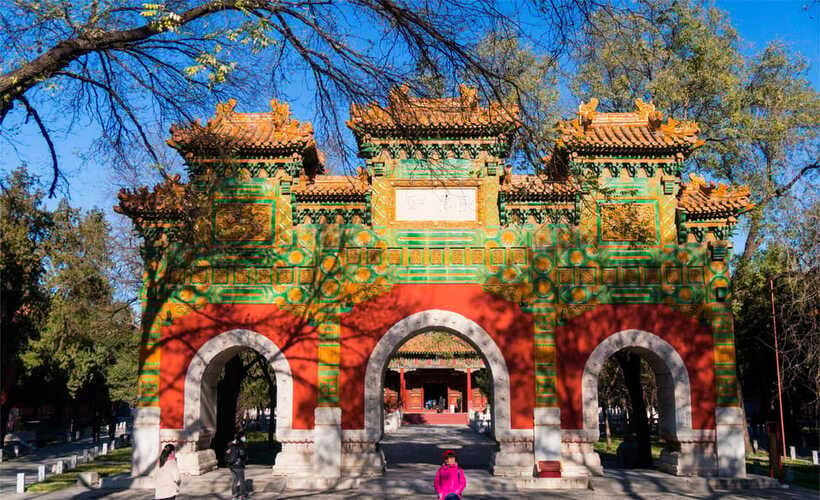
- Glazed Memorial Arch
- Biyong Hall
- Yilun Hall
- Jingyi Hall
The buildings are arranged with two halls, six main rooms, an Imperial Tablet Pavilion, and Bell and Drum Pavilions placed in a traditional symmetrical pattern. That symmetry is not just decoration. It reflects the order that Confucian education was meant to produce in both the individual and the state.
The Glazed Memorial Arch makes a useful visual pause along the route. Biyong Hall is another major feature of the college, and the formal sequence of gates and halls helps you understand the institution as a working center of education rather than simply a historic courtyard.
The college may appeal most to you if you enjoy architecture, educational history, or the structure of old institutions. If you only want famous imperial rooms filled with furnishings, this stop may feel restrained. Its value comes from the system it represents.
What you will see in the exhibitions
Three exhibitions are listed at the Confucius Temple:
- Exhibition of the Restored Dacheng Hall
- Exhibition of the Great Confucius
- Exhibition of the History of Beijing Confucius Temple
These displays add context to the buildings. The restored hall exhibition helps you understand how the temple’s main ceremonial space was used and presented. The Confucius exhibition focuses on the teacher whose ideas shaped education, government, and social conduct across East Asia.
The history exhibition ties the whole compound together. It places the architecture, ceremonies, tablets, and educational traditions into the story of Beijing. I would allow time for these displays rather than treating them as optional extras.
The provided information does not list exhibition languages or a detailed gallery plan. If you need extensive explanation in English, check at the entrance about the audio guide. A written ticket alone will not explain every carved tablet or ceremonial feature.
Swap the crowds for a different corner of Beijing:
- From Beijing: Mutianyu Great Wall Tours with Options
★ 4.9 · 9,216 reviews - Beijing: T-Square & Forbidden City Group or Private Tour
★ 4.8 · 4,446 reviews - All-Inclusive Tour: Tiananmen Square, Forbidden City, Great Wall
★ 5.0 · 2,873 reviews - MuBus: Mutianyu Great Wall ENG/ESP/RUS Guided Bus Tour
★ 5.0 · 2,361 reviews
A $7 ticket and what you actually get
At about $7 per person, the admission is strong value for a self-guided cultural visit. You are paying for entry to both the Confucius Temple and Imperial College, not for a separate walking tour or personal guide.
That distinction matters. The ticket includes the tourist attraction admission, but no guide is named and no guided commentary is included. You should plan to read the displays, follow the central routes, and decide how much time to spend at the stone tablets and halls.
The ticket is valid for one day, with starting times based on availability. The information does not specify how long a typical visit takes, so you should treat the one-day period as admission validity rather than as a fixed tour duration.
This format suits you if you prefer to set your own pace. You can move quickly through the architecture, spend longer with the examination records, or use the temple as a focused cultural stop during a day in Beijing. It is less suitable if you want a detailed personal explanation at every building.
QR entry, passport rules, and practical details
The entry process is straightforward, but the passport rule is important. You must bring your original passport and enter with the electronic ticket. The QR code by itself is not enough if staff need to match the booking to your identification document.
That means you should not rely only on a photograph or photocopy of your passport. Keep the original document available when you arrive. The simple process can save time because the ticket advertises skip-the-ticket-line admission.
The attraction is listed as wheelchair accessible. The information does not provide a detailed route map or explain which parts of the historic compounds may have uneven surfaces, so anyone needing a fully step-free route should confirm conditions before arrival.
The booking can be canceled up to 24 hours in advance for a full refund. You can also reserve now and pay later, which is useful if you are still arranging a Beijing itinerary. Those policies add flexibility, but the main practical issue remains the same: bring the passport used for the booking.
How much time should you allow?
The ticket is valid for one day, but no fixed visit length is given. I would avoid treating this as a quick photo stop. There are two large compounds, multiple gates and halls, stone tablet groups, and several exhibitions.
Your visit can be short if you mainly want the architecture and a look at the examination tablets. It becomes more worthwhile when you slow down to understand the relationship between Confucius, education, examinations, and government.
Because there is no stated meeting point, transport plan, or tour schedule, you are responsible for making your own way to the attraction and choosing your arrival time from the available options. This is best approached as independent sightseeing, even though the product is marked as a private group experience.
Who will enjoy this visit most?
I would recommend the complex to you if you enjoy:
- Chinese history and traditional education
- Formal architecture and symmetrical courtyards
- Museums with inscriptions, records, and cultural displays
- Self-guided sightseeing
- Low-cost additions to a Beijing itinerary
It is particularly useful for putting China’s civil service tradition into context. The temple shows how Confucius was honored, while the college shows how his teachings influenced state education.
Families with older children may also find the examination tablets useful because they offer a concrete way to discuss school, competition, government jobs, and social status. Younger children may need help staying interested, since the attraction is focused on buildings, inscriptions, and exhibitions rather than interactive activities.
You should think twice if your priority is a guide, a scheduled narrative, or a high-energy tour. The e-ticket handles admission, not interpretation.
What the rating tells you
The experience has a 4.4 rating from 92 reviews, which suggests broad satisfaction with the visit while leaving room for mixed expectations. The strongest practical point is the simple entry process, and the most useful extra detail is that an audio guide may be available to purchase at the temple entrance.
Two recent five-star ratings praised the experience in brief terms. One called it excellent, while another described it as a pleasant route and specifically noted the option of buying an audio guide at the entrance. That is a good clue about how to plan: book the ticket for easy access, then decide on the day if you want added commentary.
The lack of a named guide is not a problem if you are comfortable reading and exploring independently. It is a limitation if you expect a person to explain the meaning of each hall or inscription.
Should you book the Confucius Temple and Imperial College ticket?
Book it if you want an affordable, self-guided look at Beijing’s Yuan-era educational and ceremonial traditions. The stone records of 51,624 jinshi candidates are the main reason to go, while the connected temple and college make the visit more meaningful than a single historic building.
The ticket is especially good value for history-minded visitors who want flexible timing and easy QR entry. Bring your original passport, consider buying the audio guide if you want more context, and allow enough time to appreciate the tablets and exhibitions instead of rushing through the gates.
Skip it if you need a fully guided experience or have little interest in inscriptions, Confucian thought, and institutional history. For everyone else, $7 buys a thoughtful and distinctive stop that explains how education once helped organize an empire.
FAQ
How much does the Confucius Temple and Imperial College ticket cost?
The ticket costs $7 per person.
How long is the ticket valid?
The ticket is valid for one day. Available starting times depend on the date you select.
What does the ticket include?
It includes admission to the tourist attraction, covering Beijing’s Confucius Temple and Imperial College.
Do I need to bring my passport?
Yes. You must bring your original passport or ID card, and the attraction requires you to enter with your original passport and electronic ticket.
Can I enter with a QR code?
Yes. The experience uses an electronic ticket and QR code for entry. You must also present the required original identification document.
Can I skip the ticket line?
Yes. Skip-the-ticket-line entry is included in the activity information.
Is the attraction wheelchair accessible?
Yes. The attraction is listed as wheelchair accessible.
Can I cancel the booking?
Yes. You can cancel up to 24 hours in advance for a full refund.
Is a guide included?
No guide is listed as included. An audio guide may be available to purchase at the temple entrance.
Latest additions around Beijing
- Bullet Train Private Tour: Beijing Tiananmen Square, Forbidden City & Great Wall★ 5.0 · 3 reviews
- Private Hike from Beijing: Go Beyond The Jiankou and Mutianyu Great Wall★ 5.0 · 3 reviews
- Private Great Wall Hiking Tour from Simatai West to Jinshanling★ 4.5 · 3 reviews
- Private Transfer for Beijing Airport PEK or PKX★ 5.0 · 3 reviews
- Liyuan Theater Beijing Opera Show Tickets★ 5.0 · 3 reviews
- Private Jinshanling relax photo tour by sunset★ 5.0 · 3 reviews
- Private All-inclusive Jinshanling Great Wall 1-day tour★ 4.5 · 3 reviews
- Beijing Night Tour with Acrobatics Show & PekingDuck Dinner★ 5.0 · 3 reviews
Tickets, compared.

Forbidden City Tour(Group/Private)-Tickets Included
Read our review →
Mutianyu Great Wall Daily Tour with Ticket & Lunch
Read our review →
4-Hour Small Group Tour to Forbidden City with Entry Tickets
Read our review →
The Temple of Heaven or Summer Palace Entry Ticket
Read our review →
Beijing Forbidden City Ticket Booking (Optional: guide service)
Read our review →
Mutianyu Gt Wall Trip, Depart 8-10am Bus w/ Tickets
Read our review →
Forbidden City&T-Square Small GroupTours w/ ticket(Eng/Esp Guide)
Read our review →