
Reviewed · WALKING TOURS
Beijing: Peking University Campus Guided Walking Tour
Peking University is not just a famous name on a campus map. Its lakeside paths, old pagoda, carved pillars, and scholarly buildings tell the story of modern China’s intellectual life. This two-hour walking tour gives you a way into that story, with a current student explaining what the landmarks mean and what daily life at PKU feels like.
I like the route for two clear reasons: it combines major sights with small cultural details, and it gives you a student’s view rather than only a formal history lesson. Guides such as Henry have been praised for being friendly, patient, and easy to understand, even with children. The main drawback is time. Two hours passes quickly on a large campus, and one guest noted that limited campus hours made it impossible to see everything.
In This Review
- Key points
- Why Peking University deserves two hours of your Beijing time
- Meeting the guide at the East Gate
- Boya Pagoda and Weiming Lake: the visual heart of PKU
- The Bell Pavilion, Hua Biao, and Qilin statues
- Peking University Library and the statue of Cai Yuanpei
- From Yenching University to modern PKU
- Reading the gardens and courtyards
- Student life, famous alumni, and the human side of PKU
- What two hours can and cannot cover
- Is the $39 price good value?
- Who should book this Peking University walk?
- Should you book it?
- FAQ
- Where does the Peking University tour begin?
- Where does the tour finish?
- How long does the tour last?
- What language is the tour conducted in?
- How large is the group?
- What is included in the price?
Key points
- Boya Pagoda and Weiming Lake: See PKU’s most recognizable pair of landmarks and learn why they matter to the university.
- A student guide’s point of view: Hear about campus traditions, famous alumni, academic life, and modern student experiences.
- Yenching University connections: Follow PKU’s development from its earlier institutional roots and its links to Beijing’s imperial past.
- Traditional gardens with purpose: Look beyond pretty courtyards to the ideas of balance, nature, and scholarship built into their design.
- Small group of up to 10: The group size makes it easier to ask questions and keep pace on foot.
- East Gate to West Gate: Meet beside the stone lion at the East Gate and finish at the West Gate, so the walk has a clear start and end.
Why Peking University deserves two hours of your Beijing time
Many Beijing tours focus on imperial palaces, temples, and famous city walls. Peking University gives you a different side of the city: one shaped by education, debate, architecture, and student life.
The campus sits in Haidian District, an area associated with Beijing’s major universities. For you, that means a visit here can feel less like checking off a monument and more like entering a working center of study. The tour uses the campus itself as the classroom.
I especially like this approach because the university’s history is not kept in one museum room. You encounter it beside a lake, under a pavilion, near an old bell, and in the layout of gardens and courtyards. A guide can connect those pieces in a way that is hard to get from a quick solo walk.
The English-language format also matters. Names such as Yenching University, Cai Yuanpei, Yuanmingyuan, and Heshen can feel disconnected when you first hear them. A guide helps place them in order and explains why each one belongs in the story of PKU.
More walking tours in Beijing:
- Beijing Hutong Walking Food and Beer Tour at Hidden Restaurants
★ 5.0 · 1,132 reviews - Private Beijing Walking Tour of the Forbidden City with 7 Options
★ 5.0 · 675 reviews - Forbidden City Private Walking Tour with Optional Sights
★ 5.0 · 400 reviews
Meeting the guide at the East Gate

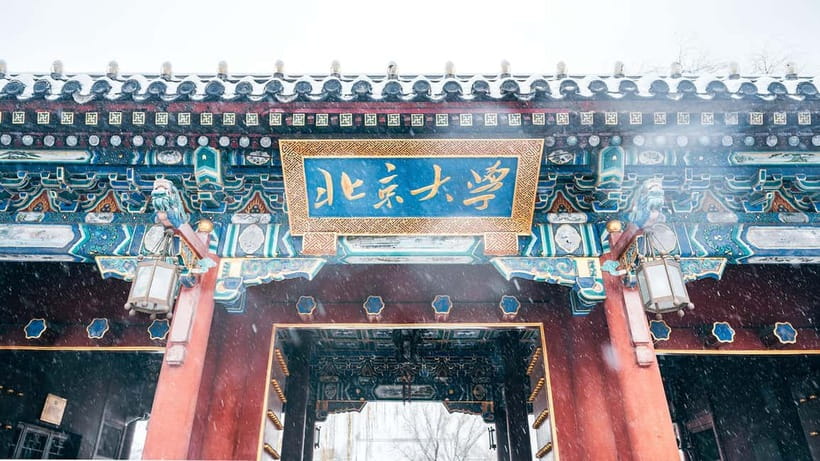
Your meeting point is the Peking University East Gate, specifically the stone lion on the right side when you face the gate entrance. This detail is useful because a large university entrance can have several possible waiting spots, and the stone lion gives you a fixed landmark.
The tour is limited to 10 participants. That is a good size for a walking route on an active campus. You can usually hear the guide without the strained feeling of a large group, and you have a better chance to ask about student routines, buildings, and traditions.
The tour is conducted in English. Henry is one guide associated with this experience, and his approach has earned strong praise for friendly communication and clear explanations. He has also handled families with children patiently, which makes the tour more workable for parents than a stiff, lecture-style campus visit.
Wear comfortable shoes. This is a genuine walking tour, not a short series of stops reached by vehicle. Bring a camera too, since Boya Pagoda, Weiming Lake, the gardens, and the old architectural details provide the best photo moments.
Boya Pagoda and Weiming Lake: the visual heart of PKU
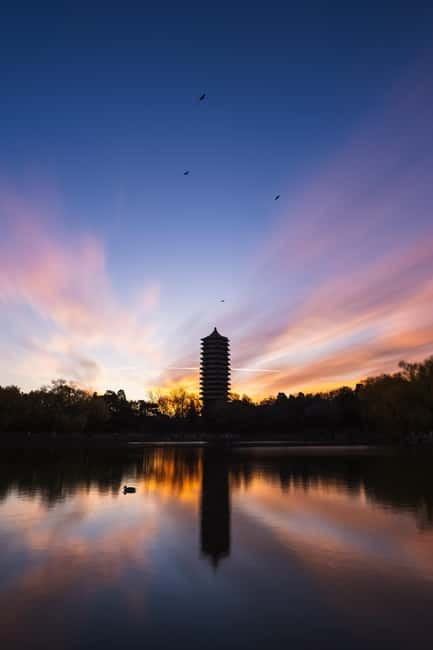
Boya Pagoda is one of the first landmarks that gives the campus its special character. The century-old structure has become closely tied to Peking University’s public image, but the guide adds the useful layer: how students and the university understand its place on campus.
Weiming Lake provides the natural setting that makes the pagoda so memorable. The route lets you consider the two together, rather than treating them as unrelated photo stops. The lake, old structure, paths, and nearby gardens create a calm contrast with the scale and pressure of university life.
I like this part of the walk because it slows the tour down. You are not simply told that a building is old or important. You can ask how the place functions in student memory, campus identity, and everyday life.
The lake is also a good point for photographs, but do not let your camera take over the experience. The value is in the explanation of how the university’s natural spaces support its academic character. The gardens are not only decoration. Their layout reflects ideas about balance between nature and scholarship.
The exact experience can vary with the guide and the pace of the group. If you stop often for questions or photos, you may cover fewer areas. That is worth accepting if you prefer a thoughtful walk to a rushed checklist.
The Bell Pavilion, Hua Biao, and Qilin statues
The Bell Pavilion adds a different note to the route. Beside the lake and pagoda, it helps show how the campus layers older Chinese cultural forms into a modern university setting.
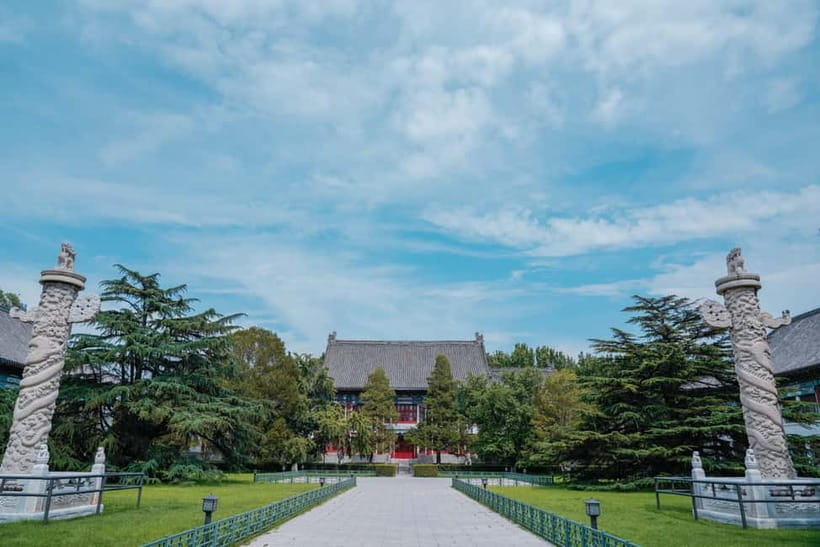
You will also see Hua Biao, or ornamental pillars, and Qilin statues. These details are easy to walk past if you are exploring alone. On a guided tour, they become chances to learn about symbolism, status, protection, and the visual language used in traditional Chinese design.
This is where a student guide can be especially useful. A guide does not just point out an object. You can ask why it is placed there, what it represents, and how students relate to it today.
The Qilin statues are also a reminder that PKU is not designed as a collection of plain academic blocks. Symbols and ceremonial features help connect the university to older Chinese traditions. The result is a campus where scholarly purpose and cultural meaning appear side by side.
For visitors who enjoy architecture, this portion may be more rewarding than a simple list of famous names. Look closely at entrances, courtyards, decorative features, and the way buildings relate to open space. The guide’s explanations help you read those choices rather than only photograph them.
A few more Beijing options to compare side by side
- MuBus: Mutianyu Great Wall ENG/ESP/RUS Guided Bus Tour
★ 5.0 · 2,361 reviews - Beijing Forbidden City Ticket Booking (Optional: guide service)
★ 5.0 · 1,263 reviews - Forbidden City&T-Square Small GroupTours w/ ticket(Eng/Esp Guide)
★ 5.0 · 995 reviews - Beijing: Summer Palace Entry Ticket and Optional Guided Tour
★ 4.7 · 810 reviews
Peking University Library and the statue of Cai Yuanpei
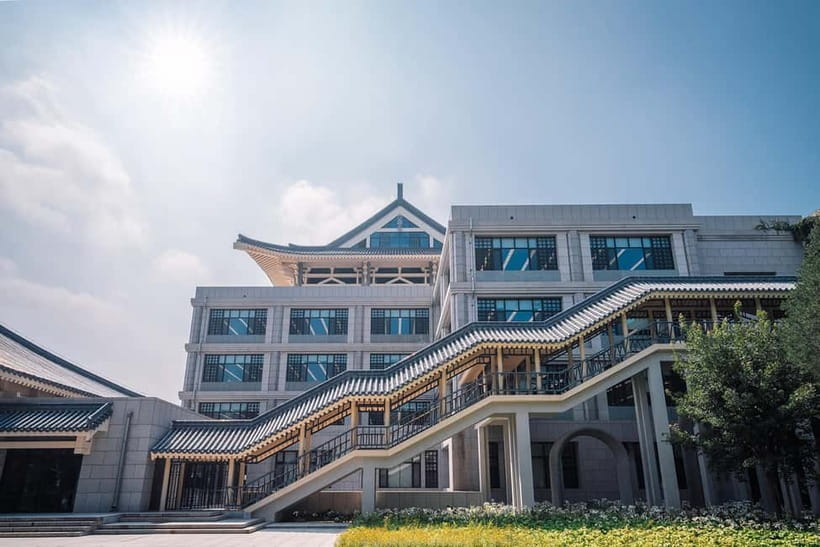
The Peking University Library is another major stop. The word grand fits the scale and role of the building, but its importance is not only architectural. It represents the university’s central purpose: study, research, and the preservation of ideas.
Your guide can place the library within the larger academic identity of PKU. That is useful if you want to understand why the university carries such weight in China beyond its appearance or reputation.
The Statue of Cai Yuanpei offers a more personal point of connection. Cai Yuanpei was a revolutionary figure and former president of Peking University. Visiting the statue gives the tour a human focus, linking institutional change to one person’s leadership and ideals.
I find stops like this more useful than a long list of dates. A name becomes easier to remember when it is tied to a statue, a place, and a discussion of the university’s direction. You may also find this section particularly worthwhile if you are interested in education, reform, politics, or the development of modern China.
The tour promises exploration of the library, but the supplied details do not specify which areas are open to the group or how much time you spend inside. Keep your expectations practical: treat this as a guided campus experience, not a full library visit or academic orientation.
From Yenching University to modern PKU
One of the strongest reasons to book this walk is the background it provides. Peking University’s story includes its roots as Yenching University, and the guide explains how the institution changed over time.
That past gives the buildings and gardens more meaning. You are not just walking through an old campus. You are following the growth of a university shaped by changing ideas about education, national identity, and China’s place in the modern world.
The route also touches on connections to the Old Summer Palace, or Yuanmingyuan, and to Heshen, the infamous Qing Dynasty official. These links broaden the tour beyond PKU itself. They place the campus within Beijing’s larger imperial and cultural setting.
This context is a good reason to choose the tour after visiting the city’s major historic sites. If you have already seen Beijing through palaces and imperial gates, the university offers another layer. You can connect the city’s older power structures with the institutions that helped shape modern intellectual life.
The subject matter can be dense, especially for visitors who do not know Chinese history. That is where your questions matter. Ask the guide to slow down, explain names again, or point out which parts are most important. The small group makes that easier.
Reading the gardens and courtyards
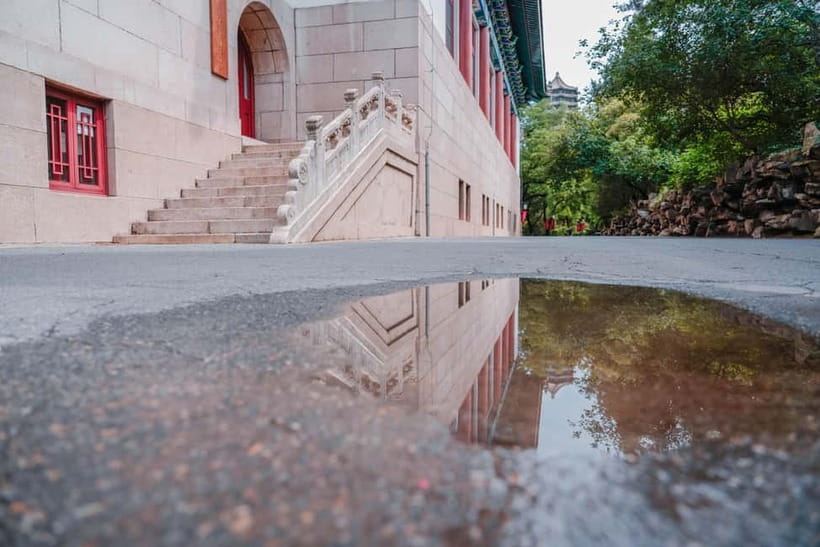
The traditional Chinese gardens on campus are not simply scenic pauses between buildings. Their design carries ideas about harmony, proportion, movement, and the relationship between people and nature.
The guide explains the meanings behind the gardens, courtyards, and building layouts. You will learn to notice how open areas frame views, how paths guide movement, and how architecture can create a quieter setting for study.
I like this part because it changes the way you see the rest of Beijing. Afterward, courtyards and gardens may look less like empty space and more like carefully planned places with a purpose.
The gardens also create a welcome change of pace. The tour includes major landmarks, but it does not treat the campus as one large outdoor monument. You get a sense of how beauty and learning are meant to work together.
Still, this is a walking tour, not a dedicated garden-design course. The guide introduces the ideas within the larger PKU story. If you are an architecture specialist, you may want more technical detail than two hours allows. For most visitors, the balance of design, history, and campus life should feel manageable.
Student life, famous alumni, and the human side of PKU
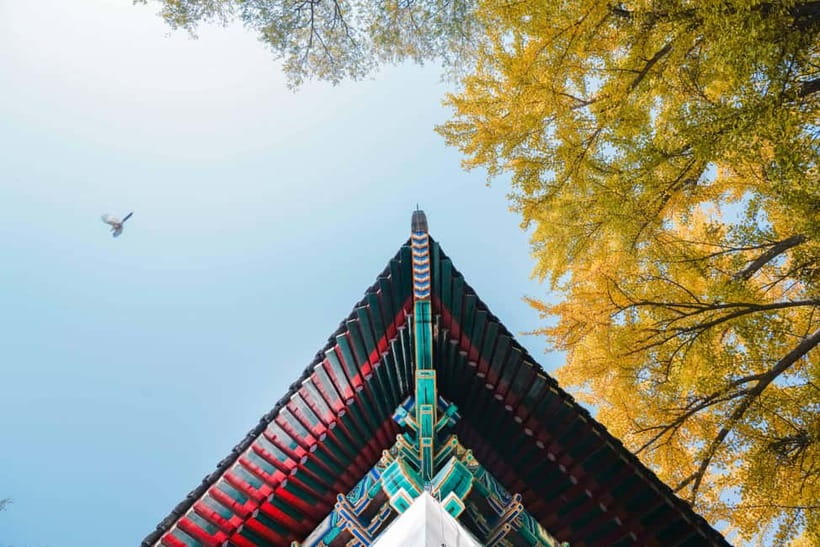
A formal campus tour can become dry if it only covers dates and buildings. This experience adds stories about student traditions, famous alumni, academic culture, and present-day life at PKU.
That student perspective is the tour’s most useful feature. You get a sense of the university as a place where people study and build routines, not only as a symbol of national achievement.
If Henry leads your walk, expect a friendly host who is easy to communicate with and willing to explain carefully. He has been praised for helping visitors connect with campus life, including families with four children and guests visiting PKU as a personal dream.
One especially nice possibility is a stop at the school cafeteria. A guest said Henry invited the group to eat there after the tour. This is not included in the price and should not be treated as a guaranteed part of the program, but it shows how the experience can move beyond sightseeing when time and circumstances allow.
Food and drinks are not included. If you hope to eat on campus, bring that plan up with the guide, but budget separately and allow enough time. The scheduled activity itself ends at the West Gate.
What two hours can and cannot cover
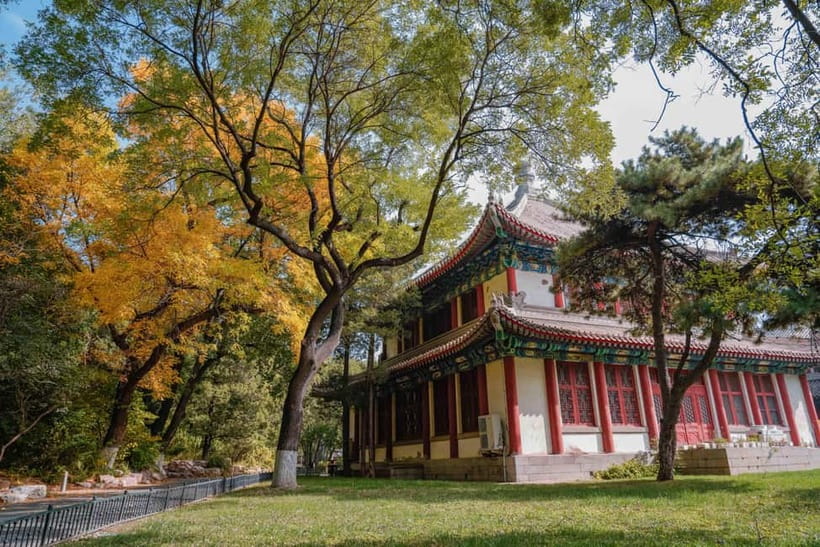
The route begins at the East Gate and finishes at the West Gate. That point-to-point design is practical because you do not need to return to the starting place, but you should plan your next stop around the West Gate rather than the East Gate.
Two hours is enough for a focused introduction to PKU. You can see the main landmarks, hear the university’s story, and ask questions about student life. It is not enough to explore every corner of a large campus.
One person specifically noted that limited hours on campus prevented a longer exploration. I would treat that as useful planning advice, not a flaw in the tour itself. Choose your priorities before you arrive. If photos matter most, save time at the pagoda and lake. If history matters most, spend more time with the guide at the library, Cai Yuanpei statue, and older campus sites.
The pace may also be affected by group interests. A small group is a benefit, but questions and photo stops can stretch the schedule. Comfortable shoes are essential, and you should arrive ready to walk for the full two hours.
Is the $39 price good value?
At $39 per person, this tour is priced above a casual self-guided walk but below the cost of a private sightseeing day. The value depends on what you want from Peking University.
If you only need photographs of Boya Pagoda and Weiming Lake, you may prefer to explore on your own. You would avoid the tour fee, though you would also miss the explanations about the Bell Pavilion, Hua Biao, Qilin statues, gardens, Yenching University, and Cai Yuanpei.
For me, the price makes sense if you care about context and want to ask questions in English. The guide turns a large campus into a connected story, and the group limit of 10 keeps the experience more personal than a mass tour.
You also get a clear two-hour commitment, which helps on a busy Beijing schedule. There is no food, drink, or transportation included, so add those costs if needed. You must make your own way to the East Gate and arrange your onward transportation from the West Gate.
The booking terms offer some useful flexibility. You can cancel up to 24 hours in advance for a full refund, and you can reserve now and pay later. Check available starting times before booking, since the experience runs at scheduled times rather than whenever you arrive.
Who should book this Peking University walk?
I would recommend it to:
- History fans who want connections between PKU, Yenching University, Yuanmingyuan, and Qing-era Beijing.
- Architecture lovers who enjoy gardens, courtyards, ornamental pillars, statues, and campus planning.
- Prospective students and families who want a firsthand look at academic culture and student life.
- English-speaking visitors who want explanations and conversation rather than a silent campus stroll.
- Photographers interested in Boya Pagoda, Weiming Lake, traditional features, and ceremonial architecture.
- Families with older children who can manage two hours of walking and benefit from a patient guide.
I would be more cautious if you dislike walking, want a broad Beijing sightseeing tour, or expect extended indoor access to the library and other buildings. The tour is focused on PKU, not a general Haidian District excursion.
Should you book it?
Book this tour if you want to understand why Peking University matters, not just take a picture at its gate. The strongest parts are the student guide, the mix of famous sights and overlooked symbols, and the explanation of how gardens and buildings express academic ideals.
The main limitation is simple: two hours cannot cover everything. Plan for a focused introduction, wear good shoes, and leave room for the guide’s stories. At $39, it is a fair choice for visitors who value context, personal explanation, and a look at modern China through one of its leading universities.
FAQ
Where does the Peking University tour begin?
The tour begins at Peking University East Gate. Meet at the stone lion on the right side when facing the gate entrance.
Where does the tour finish?
The walk finishes at Peking University West Gate.
How long does the tour last?
The guided walking tour lasts two hours.
What language is the tour conducted in?
The tour is conducted in English with a live English-speaking guide.
How large is the group?
The group is limited to 10 participants.
What is included in the price?
The price includes the two-hour guided walking tour, visits to historical landmarks and cultural sites, stories about PKU’s past, and insights into student life. Food, drinks, and transportation to and from the university are not included.
Latest additions around Beijing
- Private Hike from Beijing: Go Beyond The Jiankou and Mutianyu Great Wall★ 5.0 · 3 reviews
- Bullet Train Private Tour: Beijing Tiananmen Square, Forbidden City & Great Wall★ 5.0 · 3 reviews
- Private Great Wall Hiking Tour from Simatai West to Jinshanling★ 4.5 · 3 reviews
- Private Transfer for Beijing Airport PEK or PKX★ 5.0 · 3 reviews
- Private All-inclusive Jinshanling Great Wall 1-day tour★ 4.5 · 3 reviews
- Liyuan Theater Beijing Opera Show Tickets★ 5.0 · 3 reviews
- Private Jinshanling relax photo tour by sunset★ 5.0 · 3 reviews
- Beijing Night Tour with Acrobatics Show & PekingDuck Dinner★ 5.0 · 3 reviews
Walking Tours, compared.

Beijing Hutong Walking Food and Beer Tour at Hidden Restaurants
Read our review →
Private Beijing Walking Tour of the Forbidden City with 7 Options
Read our review →
Forbidden City Private Walking Tour with Optional Sights
Read our review →

Beijing City Walk: Explore Hutongs Life and Old Beijing
Read our review →
Highlights of Forbidden City Private Walking Tour
Read our review →
Browse the lists this tour appears in